Friday, June 21, 2013

Time Frame Continuity

The importance of time frame continuity with AAPL

Turned a profitable day into a losing day by losing sight of time frame continuity- Sized up on trade C. with 2 options trade.  Trades A and B both profitable options trade.


A short setup to add to my Playbook:

Short covering off bottom, inside 5 makes a lower high and in the top 1/3 of large green candle. Short break of inside 5


Thursday, June 13, 2013

Bad Trading Day

ULTA had a huge gap up move yesterday, but closed very weak.  The stock opened lower this morning and I was looking for a move lower.  My bias was short, and failed to pay attention to what the tape was telling me.

1. First short entry is one of my favorite trades.  Look for an inside 5 minute bar after a large initial move and look for a break of the inside 5 (ideally in the original direction).  Good trade, got stopped out before the big drop.

2.  Looked to enter long, which was the play for today.  Entered on break of inside 5 minute bar, but was distracted (at work and sold the position).  This would have held up all day long as the stop price was never breached.

3.  Looking short again on break of inside 5 minute bar, again stock was too strong and stopped out. This should have been a clear indication that the tape was looking higher - Higher lows being put in, and shorts quickly stopped out.

RULE BREAK.

One of my rules is that I am done trading if I have 3 losing trades in a row.  I had a loss of $49 for the day.


4.  Looked long as my short was stopped out.  I was looking long as a my stop was at the break of an inside 15 minute bar ($95.87).  Entered @ $95.91 with a stop at $95.73.  Instead of following the strategy, I decided to exit the position (fear) and stopped out @ $95.85.  The trade would never have stopped out and continued to 97.50

5.  Rule break 3 & 4
Shorted break of shooting star with 3x size. Quickly stopped out.  Loss for the day -  $189

Lessons learned today.

Follow the strategy, especially where to place the stops.
Don't break my trading rules.
OK to have a bias but watch the tape

Saturday, April 28, 2012

Shorting Rounded Tops

Played MDRX on the long side than the short side today.  MDRX had negative news on earnings and had a huge gap down.  GMAN said that the stock was holding the $9 level.  My entry was @ 9.25.  The price was above the 9EMA and 20 SMA and flagging.  Sold a quick 1/2 @ 9.50, and 1/4 @ 9.82.  I added another position when the stock broke the HOD @ 9.87.  Sold a quick 1/2 @ 10.  I meant to place my Stop @ 9.85 but placed it @ 9.90 (ITrade's new platform sucks) and got wicked out, or I could have enjoyed the nice run to 10.50!!
The stock topped out @ 10.51 and started forming a rounded top.  I shorted at 10.32 (previous level) for a quick gain.  1/2 @ 10.12 and 1/2 @ 10.28. Once the price action broke above 10.24, the trade had reversed and exited.  It made a lower high and came back to the same level.  I shorted at 10.29 this time, but there was no follow through and exited for scratch.
Here are the 1 minute and 5 minute charts.  I saw the trade much better on the 1 minute chart.


I noticed the rounded top as a result of a conversation I had with my buddy @Ktrades this week as we were discussing price action.  Thanks!!!

Sunday, April 1, 2012

Shorting Setup for Playbook

From BCLUND
  1. The overall stock market is overbought, in a trading range, or trending down, not breaking out or oversold, and
  2. The stock I am shorting–its industry is in a downtrend, and
  3. The stock I am shorting has entered a downtrend itself.
Look for certain chart patterns (and these apply on any timeframe). I want to see the stock first move in a “false” direction, breaking out to the upside, then reverse and hit a new low for the day, then when it tries to bounce back and rally towards that daily high, I enter the short position as it approached that high and place a stop from .01 to .20 cents above that day’s high price.


Friday, March 30, 2012

Playbook


Context Matters: Why BIDU was a short and CF was not
Last week I wrote a blog that discussed an excellent short setup in BIDU from May 16th.  BIDU was trending down on the daily time frame and offered a very low risk intraday trade on the short side after running up on the Open and then forming a rounded top.  I tasked one of our trainees to continue to look for similar setups and to execute when she found these trading opportunities.
Today, while broadcasting live on StockTwits.tv I received a question regarding a trade in CF one of our trainees was considering making.  He thought that CF presented a good shorting opportunity with a very small clearly defined amount of risk with 1 to 2 points of upside.  I wondered if my discussion of the BIDU short had influenced him to think that CF offered a good  shorting opportunity as well.  Similarly to BIDU last week CF had a powerful up move on the Open then began to move sideways.  That is roughly where the similarity ends.
My response on stocktwits.tv regarding this setup can be found here at the 21:30 mark of the video.  CF unlike BIDU was not in a downtrend on the daily time frame.  It also had just broken above the highs from the prior two trading sessions.  And this strength was being exhibited on a day when the market was down over 1%.  This was a stock that was trending higher on virtually all time frames.  This stock was a long.
In law school one of the common techniques used on exams is to make small changes in fact patterns and then ask students how these changes would alter their conclusions.  If you are attempting to be a professional intraday trader I would suggest that you employ this technique to help sharpen your trading skills.  When reviewing your work make subtle changes in the conditions that you encountered when examining a stock for a potential trade.  How would these changes impact your conclusions?
CF and BIDU charts for your review:


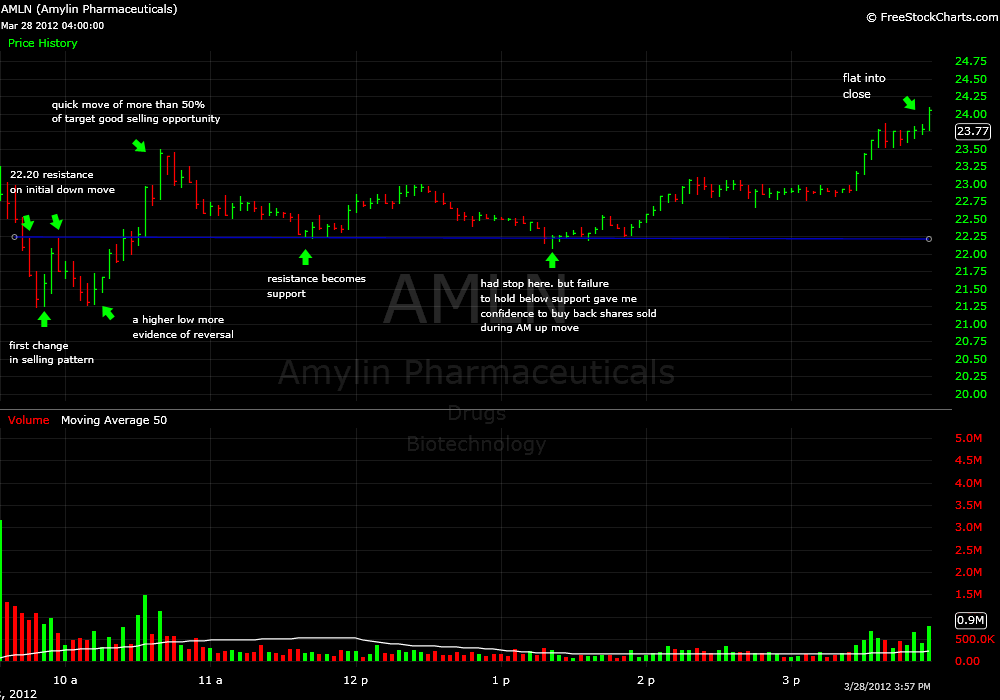
I loved the AMLN Second Day Play near 23, an important level from yesterday.  Yesterday AMLN was In Play, could not get above 23, and then did with a nice push in the closing hour.  A pullback to near 23 was an A+ Second Day Play.  I placed a bid at 23.03 and just missed a fill.  AMLN touched every price save my bid.  I had that feeling that I am not a part of the market place.  Later I bought 23.38 and am just holding now.


Tuesday, February 21, 2012

TraderFeed

The simplest journal I recommend new traders keep is simply to identify--each day--one thing that you did wrong that you'd like to correct the next day and one thing that you did right that you'd like to build upon tomorrow. The reason for this journal format is that it balances the problem emphasis with a solution focus. If you only improve your deficits, at best you'll go from deficient to average. The elite performers in any field identify their strengths, build on those, and find ways to compensate for and work around weaknesses. 

In some measure, in some ways, you're *already* the trader you want to be. Once you realize that, it's only a matter of crystallizing your strengths, turning them into habits, and building your consistency. Greatness is more than the relative absence of problems; it's the purposeful cultivation of one's most distinctive capabilities.


(TraderFeed)
http://traderfeed.blogspot.com/2009/01/keys-to-solution-focused-trading.html


Letting Profits Run: A Guide to Becoming Your Own Trading Coach

My most recent post emphasized many of the basics that enable people to become their own trading coaches. For this last post in the series, let's apply those basics to one of the most common trading problems that people describe to me: the difficulty of letting profits run.

From the previous post, it should be clear why this is such a difficulty:We set our profit targets and trade strategy while we are in one state of mind but then, as the trade progresses, we enter an entirely new state. That new state very often involves worried thoughts about losing unrealized profits or having gains turn into losses. It generally brings an elevated heart rate, increased muscle tension, and more rapid and shallow breathing. As we become aware of the nervous feelings, that helps to perpetuate the negative thoughts and altered physical state, which in turn can amplify the anxiety. Very often, cutting positions short before profits can run is simply a coping device to manage this anxious state. We exit the position for emotional relief, not for reasons of sound strategy and money management.

The solution focused approach calls on us to review those occasions in which we have been able, in some measure, to let profits run--even just a bit. What did we do differently on those occasions? Those exceptions from our problem patterns are what we have to build upon: they are our potential solutions.

In my case as a trader, there are several things I've done differently when I've been successful in letting profits run:

* I have planned the trade well in advance with research; it is not a spontaneous trade, so I've had time to think clearly about what I want to do.

* I have a clear profit target in mind based on research and refuse to waver from that target unless the market takes me out with a predefined stop. I consider myself a person of integrity, so I tell myself that I have to show integrity and loyalty to my trade idea and target;

* I don't follow the position tick for tick. Either the trade will hit my target or it will hit my stop. I make a conscious effort to let go and not micromanage the trade;

* I keep myself calm and clearly focused by purposely getting up from my chair, doing some stretches, breathing deeply, and getting away from the screen. I keep myself in a state that is incompatible with anxiety;

* I rehearse constructive self-talk during the trade. I tell myself that I've done my preparation and established my edge. Any individual trade can go against me, but if I take all the good trades I can, eventually I'll benefit from good odds and a good risk-reward ratio. If I lose money on the trade, I'll figure out why and what that might be telling me about the current market.

All of these steps, taken together, form a template for how I manage to hold onto positions to maximize profits. Now the key is to turn this template into a habit pattern. I want it to become automatic--an internalized part of me.

To accomplish this, I wear my heart monitor and go out for a morning jog prior to the market open. I use the monitor to ensure that I maintain an elevated heart rate and a good jogging pace. While I'm running, I'm mentally rehearsing each aspect of my template. I'm imagining my trades, and I'm imagining what I'll do if they move in my favor. I rehearse the proper self-talk, and I imagine getting away from the screen and staying loose. I also imagine, with plenty of emotion, how happy I'll be sticking to my ideas and reaping enhanced profits. In short, I'm getting physically *and* emotionally pumped up during the jog.

This becomes a routine every morning. Repetition and powerful emotion are the keys to turning patterns into routines and setting new spots on our radio dial of consciousness. After a while, those thoughts, images, and feelings from my jogs begin to appear on their own, as they increasingly become familiar parts of me. Then, during my break from the screen while I'm letting a trade run, I go on my treadmill for a few minutes or simply jog in place. I get myself back into the pumped up state and recruit everything I've rehearsed.Instead of feeling anxious while riding the trade, I'm feeling energized.

Again and again, during each trading day.

Notice that you could substitute any desired behavior for the holding onto trades and make this technique work for you. It does take practice and repetition, but once you have a positive habit pattern, you have it potentially for life. The key is focusing on your strengths and turning those into patterns that can be triggered when you enter into associated states of mind and body. In my example, I used jogging to create the unique state. I could have just as easily chosen meditation or self-hypnosis.

Once you grasp this method and become good at it, there are many positive patterns you can program--in your work, relationships, and trading. There is no need to become bogged down in problems when you can build upon your own solutions.

Finding Solutions to Your Trading Problems


My talk at the Annual Meeting of the American Psychiatric Association in Toronto yesterday afternoon concerned solution-focused brief therapy (SFBT). I continue to find it one of the most applicable short-term change technique to trading problems. It has also been used commonly and successfully with relationship and parenting concerns, as well as with overcoming personal barriers to reaching goals.

What makes the solution-focused approach unique is that it starts with the assumption that many problems that emotionally healthy people encounter are the results of their becoming too problem focused. In other words, once people become convinced that they have a problem, their subsequent actions unwittingly reinforce this problem, creating a damaging, circular pattern.

The classic example is the person who doesn't sleep well for a couple of evenings. He becomes convinced that he has an insomnia problem, and now starts worrying about his problem and taking extra steps to *make* himself sleep. All of these simply interfere with normal sleep processes and prolong the original concern.

This occurs with traders as well. Just as there can be chance streaks of wins, there are random losing streaks. Once traders define these as "slumps", they alter their trading, becoming overly cautious at times and overly aggressive to regain losses at other times. These changes to normal, good, planful trading only make the slump worse, creating the self-reinforcing problem.

The solution-focused approach gets away from this problem immersion and, instead, emphasizes *exceptions* to problem patterns. These are potential solutions.

For instance, it is very common that traders even in bad slumps make some good trades and have some good days and weeks. The solution-focused approach takes a hard look at these and pushes traders to identify what they're doing right when they're making money. These exceptions to slumps become positive behaviors that can then be codified as trading rules and mentally rehearsed before each day's trade. Pretty soon, the trader is doing more of what works and no longer feels in a slump.

The solution-focused approach suggests that sometimes the problem is not a deeply rooted psychological conflict. Sometimes we become too problem focused for our own good. No one ever succeeded merely by reducing or eliminating negatives. Our strengths are all we have to build upon.

http://traderfeed.blogspot.com/2007/04/solution-focused-linkfest.html